
Johnson County parents' guide
The Parents' Guide to Martial Arts in Johnson County.
What the styles are, how the Taekwondo organizations differ, what to look for in any school and the questions to ask before you sign. Fair to every style, with sources you can check. Written by KOMA, teaching Johnson County families since 2006.
Most children are ready for organized classes at about age 6, and a younger child can do well in a class built for that age: short, playful and without competition. No style is best for every child; the school and the instructor matter more than the style. In Taekwondo, the organization behind a school (Kukkiwon, ATA, Tiger-Rock, ITF or none) decides the forms, the belts and who issues the black belt. Before you enroll, watch a class, ask for the total cost for a year in writing, and read the agreement before you sign. Kansas has no law written for martial arts contracts, so the agreement is what counts.
Before you start
The style matters less than the school.
Most martial arts schools look the same from the parking lot. This page gives you the short answer to the twelve questions Johnson County parents ask most, so you can walk into any school and know what to ask.
We wrote it at KOMA, a Taekwondo studio in South Overland Park, North Olathe and Prairie Village, so we have a stake in your decision. We have tried to be fair to every style and every school, with sources you can check. And one piece of advice before anything else: the school matters less than the instructor who will be standing in front of your child twice a week.
Free download
Get the full guide and the school visit checklist.
Get all 12 chapters as a PDF, with the research behind every answer and the two page school visit checklist to take on every visit.
- The full guide: ages, cost, styles, Taekwondo organizations, belts, ADHD, contracts
- The school visit checklist: compare up to three schools side by side
- Sent to your inbox in a minute
Download form goes here
Chapter 1
Is my child old enough?
Most children are ready for organized classes at about age 6. A younger child can do well in a class built for that age: short, playful and without competition.
A good class for a 4 or 5 year old is short, playful, taught by show and tell, grouped by age and has no sparring or tournaments.
Chapter 2
What does it cost?
No reliable price list exists. Ask every school for the total cost for a year, in writing, with every fee in it.
Tuition is only one cost. Enrollment, uniforms, testing fees, sparring gear, upgrade programs and events can all add to it.
Chapter 3
Karate, Taekwondo, martial arts: what's the difference?
Karate is Japanese and Taekwondo is Korean. Martial arts covers both and more. Schools use the words loosely, so ask what the curriculum is based on.
Some Taekwondo schools still put "karate" on the sign, and some schools say only "martial arts" without naming a style.
Chapter 4
The styles, side by side
No style is best. Choose by what you want for your child, then by the school and the instructor.
Practice without contact carries less risk of injury than sparring. Ask every school when children start sparring, how hard, and whether head contact is allowed.
Chapter 5
Taekwondo isn't one thing
The organization behind a Taekwondo school decides the forms, the belts and who signs the black belt certificate. Ask which one it is.
Rank may not carry over between organizations, and a child who changes schools may have to learn a new set of forms.
Chapter 6
Belts and black belts
There is no universal standard for belts. Ask how students earn them, what each test costs and how long black belt takes.
A school that promises a black belt by a fixed date is selling the belt. A black belt is the start of serious training, not the end.
Free download
Want the whole story behind these answers?
Get all 12 chapters as a PDF, with the research behind every answer and the two page school visit checklist to take on every visit.
- The full guide: ages, cost, styles, Taekwondo organizations, belts, ADHD, contracts
- The school visit checklist: compare up to three schools side by side
- Sent to your inbox in a minute
Chapter 7
Martial arts, a team sport or a rec program?
Team sports and martial arts give a child different things. For many families the best answer is both.
Experts advise children to sample several sports through age 12. Martial arts twice a week leaves room for a season of soccer.
Chapter 8
ADHD and special needs
Exercise helps children with ADHD. Martial arts has not been shown to help more than other activities, but a well run class suits many children.
What helps is a predictable routine, short clear instructions, constant movement and quick feedback. Those come from the class and the instructor, not the style.
Chapter 9
What to look for in any school
Watch one class. The instructor, the way children are grouped and the school's safety practices tell you most of what you need.
Kansas requires no license or background check to teach martial arts, so ask each school what its own policy is.
Chapter 10
Before you sign
Kansas has no law written for martial arts contracts. The agreement you sign is what counts, so read it before you sign.
Read for the term, automatic renewal, how to cancel, who you are paying and whether the rate can rise. Slow down if you are pushed to sign the same day.
Chapter 11
Johnson County at a glance
Nearly every style in this guide is taught within a short drive of your home.
Johnson County has Taekwondo of every kind, about as many jiu-jitsu schools, and rec center classes in several cities.
Free download
Take the checklist with you.
Get all 12 chapters as a PDF, with the research behind every answer and the two page school visit checklist to take on every visit.
- The full guide: ages, cost, styles, Taekwondo organizations, belts, ADHD, contracts
- The school visit checklist: compare up to three schools side by side
- Sent to your inbox in a minute
Chapter 12
How KOMA does it
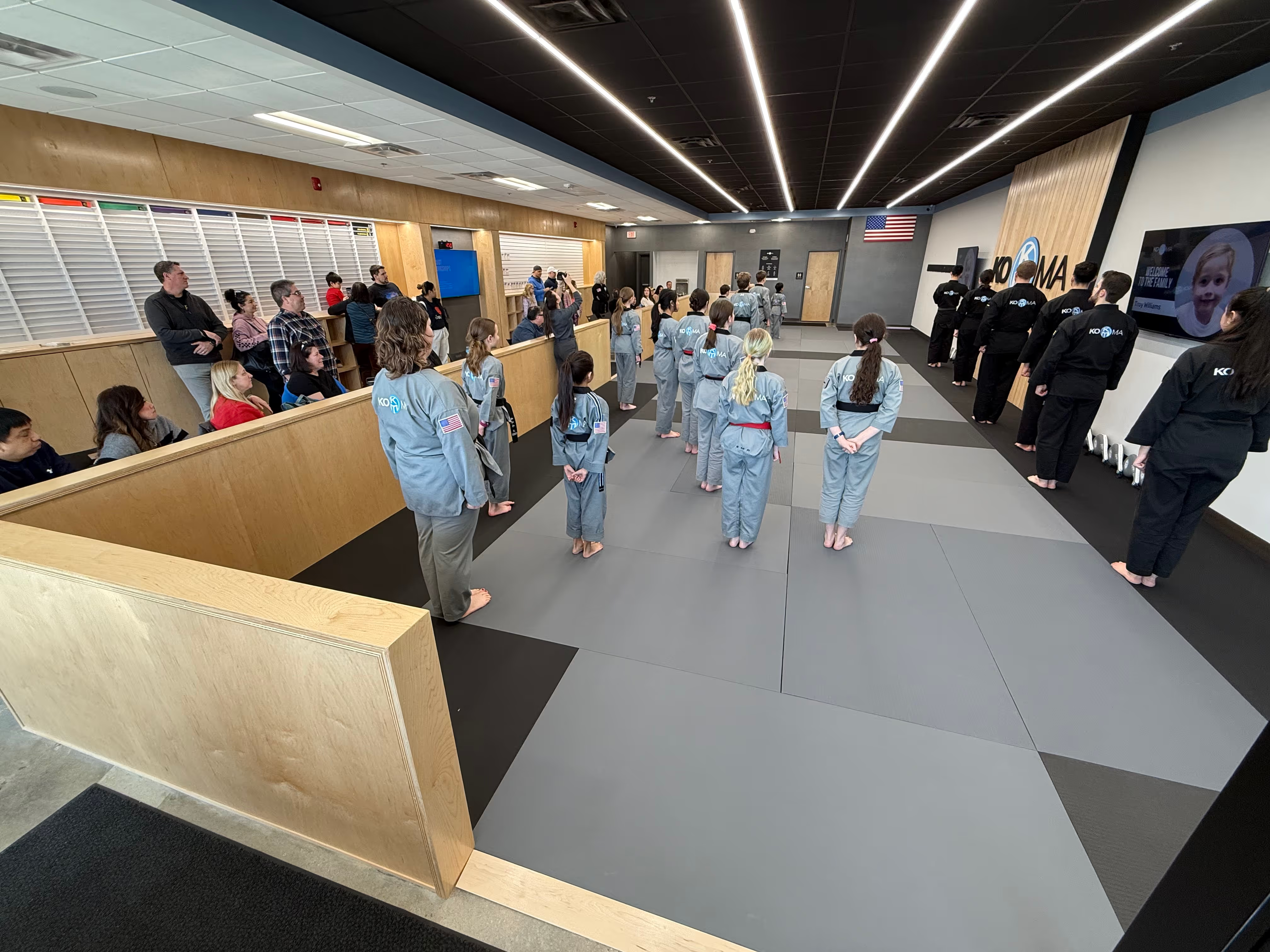
KOMA was founded in 2006 by Master Ko. We teach Taekwondo to children, teens and adults at three studios: South Overland Park, North Olathe and Prairie Village. Children from age 4 train in two 45 minute classes a week, grouped by age, and parents are welcome to watch every class. We will give you our prices in writing before you decide anything.
Every family starts with an Intro to KOMA lesson at the studio nearest you. It is a real lesson with an instructor, and the best way to find out whether we are the right fit for your child. If we aren't, we will tell you.
Sources
Where the facts in this guide come from.
- American Academy of Pediatrics, HealthyChildren.org, "Is Your Child Ready for Sports?"
- American Academy of Pediatrics, "Youth Participation and Injury Risk in Martial Arts," Pediatrics, 2016
- Stamenković and others, review of martial arts and children's fitness, Children, 2022
- Ng-Knight and others, trial of school Taekwondo and self-regulation, Developmental Psychology, 2022
- Gubbels and others, 2016, and Harwood and others, 2017, analyses of martial arts and behavior, Aggression and Violent Behavior
- Hoffmann and others, "Associations between organized sport participation and mental health difficulties," PLoS One, 2022
- Aspen Institute Project Play, sport sampling guidance
- CHADD and Nationwide Children's Hospital on sports and ADHD
- Kukkiwon, World Taekwondo, USA Taekwondo, ATA Martial Arts, Tiger-Rock Martial Arts and the International Taekwon-Do Federation, each from its own website and published rules
- World Karate Federation, USA Judo, International Brazilian Jiu-Jitsu Federation, International Federation of Muaythai Associations and International Mixed Martial Arts Federation youth rules
- Kansas Consumer Protection Act and Kansas Administrative Regulations
- U.S. Center for SafeSport


Start with an Intro to KOMA.
Your child takes a real class while you meet our team. We will help you choose the right program for your family.
Schedule your Intro