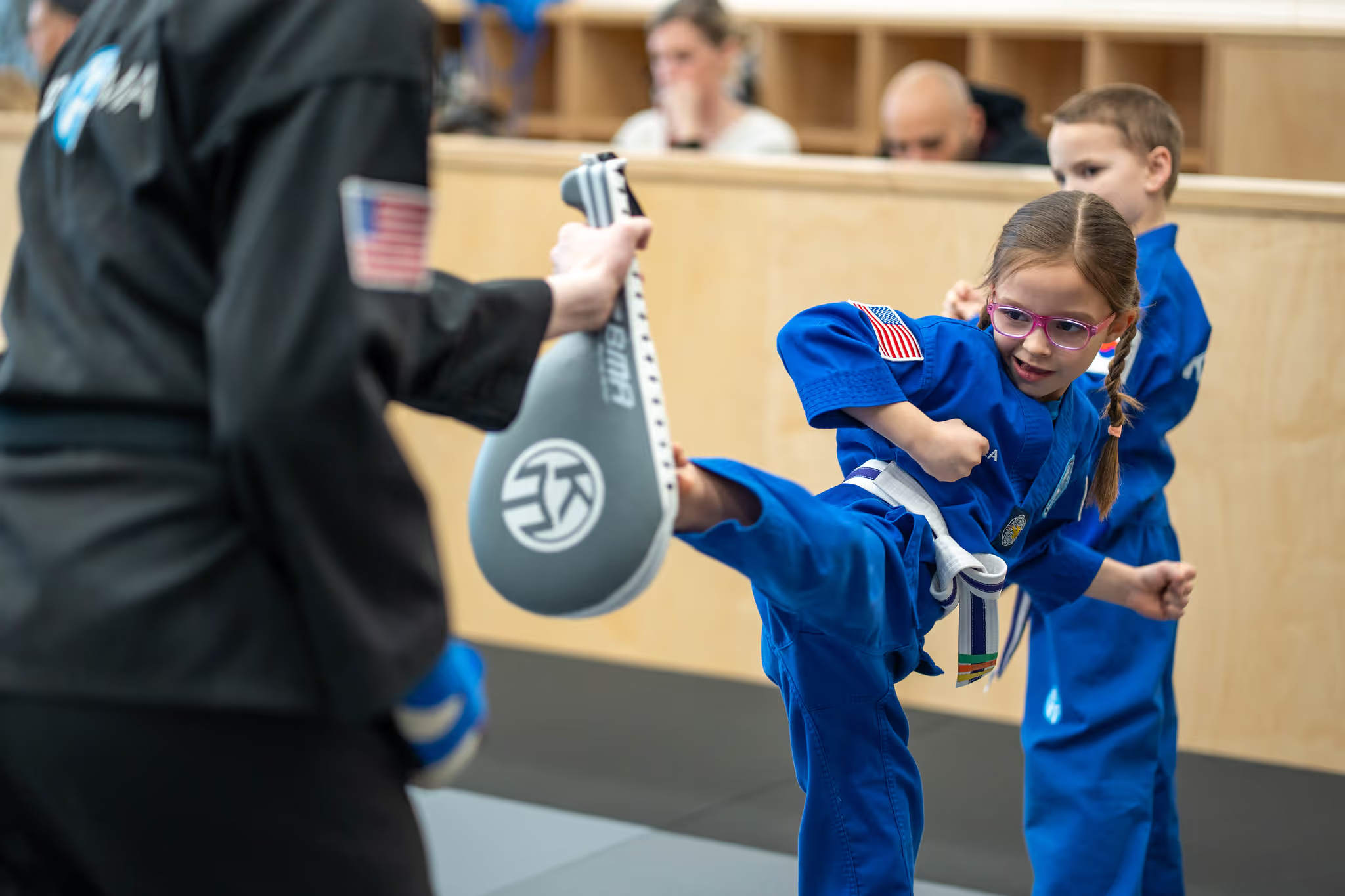
Your child does not want to play team sports.
You signed him up. You drove him there. Somewhere around week two, something shut off. He started dragging his feet in the driveway. He said he did not like it.
And now you are wondering what that says about him. Or about you.
Nothing is wrong with your child. After teaching martial arts in Johnson County since 2006, Master Ko has watched this exact pattern a few hundred times, and it almost never means what parents think it means.
The label that outlasts the season
Here is how it usually goes.
You push a little. He digs in. You push harder. And after a season or two, everyone in the house quietly agrees on the same conclusion. He is just not athletic.
Now consider what actually happened there. A nine year old just received a sentence about himself, from the people he trusts most, and he is going to repeat that sentence for the next twenty years.
That is what is really at stake. Not a sport. A story your child starts telling about who he is.
What a team actually asks of a child
To understand why he shut down, it helps to look at what a team is really asking him to do.
It asks him to do a hard thing. In public. On a clock. In front of other parents. Before he is any good at it yet. And if he misses, other people lose something.
For a lot of children, that is fine. It is good for them. They rise to it.
But think about the child who is already careful. Who reads the room before he speaks. Who is already worried about letting somebody down.
What does that arrangement teach him?
It teaches him exactly one thing. The safest way to avoid failing in front of everybody is to avoid trying in front of everybody.
So he goes quiet. He stands at the back. He tells you he does not like it.
Parents hear that as a lack of interest. It is almost never a lack of interest. It is protection.
Why pushing harder and backing off both fail
Most families try one of two responses, and both of them make it worse.
The first is to push harder. Sign him up again, insist he finish the season, treat the reluctance as something to be overcome. For a child who is protecting himself, more pressure simply confirms that the environment is unsafe. He gets better at going quiet.
The second is to lower the bar. Find something easier. Ask less of him. This feels kind, and it is the more common mistake among caring parents. But lowering the standard tells a child something he is already afraid might be true, which is that you do not believe he can meet it.
What a child like this actually needs is neither. He needs a place where the work belongs to him, where the only person he is measured against is himself from last month, and where the standard does not move.
Why Ko Martial Arts does not have a competition team
About eight years ago, Master Ko shut down the competition team at Ko Martial Arts.
It represented maybe five percent of the student body, and it was consuming nearly all of his time and energy. So he asked a simple question. Who are our people?
The answer was not the five percent.
The students Ko Martial Arts is built for are the ones who are not naturally athletic. Who struggle with sports. Who are more academic, more intellectual, more inward. Those are the families the academy serves best, and building the whole program around trophies would have meant serving them worse.
So there is no competition team, and there is no trophy chase. That is a deliberate choice, and it is the reason a hesitant child fits here in a way he may not have fit elsewhere.
What this looks like on the mat
A few years ago a boy started at Ko Martial Arts who would not step onto the mat at all. For three weeks he stood at the edge and watched. His mother had already withdrawn him from two other activities and told Master Ko she expected this to be the third.
Nobody pushed him on. Nobody lowered anything either.
His first month, the entire curriculum was this. Stand still. Hands at your sides. Look an adult in the eye and answer him. Nothing athletic happened for a month.
By month four he was correcting his own stance before an instructor got to him.
By his second year he was the one helping a newer student tie a belt.
When his mother described what had changed, she did not mention a kick or a form. She said he had stopped saying I cannot do it before he tried it.
How a student earns a rank here
Parents evaluating a premium program deserve a specific answer about how rank works, so here it is.
Belt cycles run thirteen weeks. The calendar is set. What is not set is whether your child tests at the end of one.
To test, a student has to earn all of his stripes and he has to be here. If he has not done both, he does not test. That is not a punishment. That is the standard.
This matters for a hesitant child more than it might seem. The requirements are objective. Nothing depends on whether an instructor happens to like him, and nothing depends on how he compares to the student beside him. The outcome sits in his own hands, which is precisely what a team could not offer him.
A new student is also never put in front of the room. He earns his way to the front. And nothing your child does or does not do costs another family a game.
This is not an argument against team sports
Plenty of students at Ko Martial Arts play team sports, and they are good for them.
But if your child has told you three times that he does not want to, it is worth listening to what he might actually be saying. He may not be telling you he is lazy. He may be telling you he does not want to be watched yet.
What to do next
The next step is small.
Come watch a class at any of our three Johnson County locations. Sit in our lobby and give us thirty minutes. Do not watch the students. Watch how a correction sounds when an instructor gives one. That will tell you more about whether this fits your child than anything written on this page.
If it looks right, book an Intro to KOMA. It is one lesson in a small group, and if your child is not ready for a group, tell us when you book and we will run it one on one. That happens more often than parents expect.
And if your child is the one who will stand at the edge of the mat and not come on, say so when you book. That is not a problem here. That is where a lot of our best students started.
Common questions from parents
My child has quit every activity we have signed him up for. Why would this be different?
Because the requirements here are objective and the pace is his own. He is not competing for playing time, and no result depends on him performing before he is ready. Many of our long term students arrived after two or three activities did not stick.
My child is shy and will not want to join a class full of strangers.
Tell us that when you book your Intro to KOMA and we will run the lesson one on one. Several of our students began exactly this way.
How long before we see a change?
We do not promise a timeline, and you should be careful with any program that does. What we can tell you is that the change parents report first is usually not physical. It is a child who stops saying I cannot do it before trying.
What ages do you serve?
Ko Martial Arts serves children, teens, and adults across Johnson County.
Our locations
Ko Martial Arts, South Overland Park - 15030 Antioch Road, Overland Park, KS 66221, 913.851.2400
Ko Martial Arts, North Olathe - 21701 College Blvd, Olathe, KS 66061, 913.829.2929
Ko Martial Arts, Prairie Village - 5320 W 95th St Unit B107, Prairie Village, KS 66207, 913.228.0555
Serving families throughout Johnson County, including Overland Park, Olathe, Prairie Village, Leawood, Lenexa, Shawnee, and Mission since 2006.